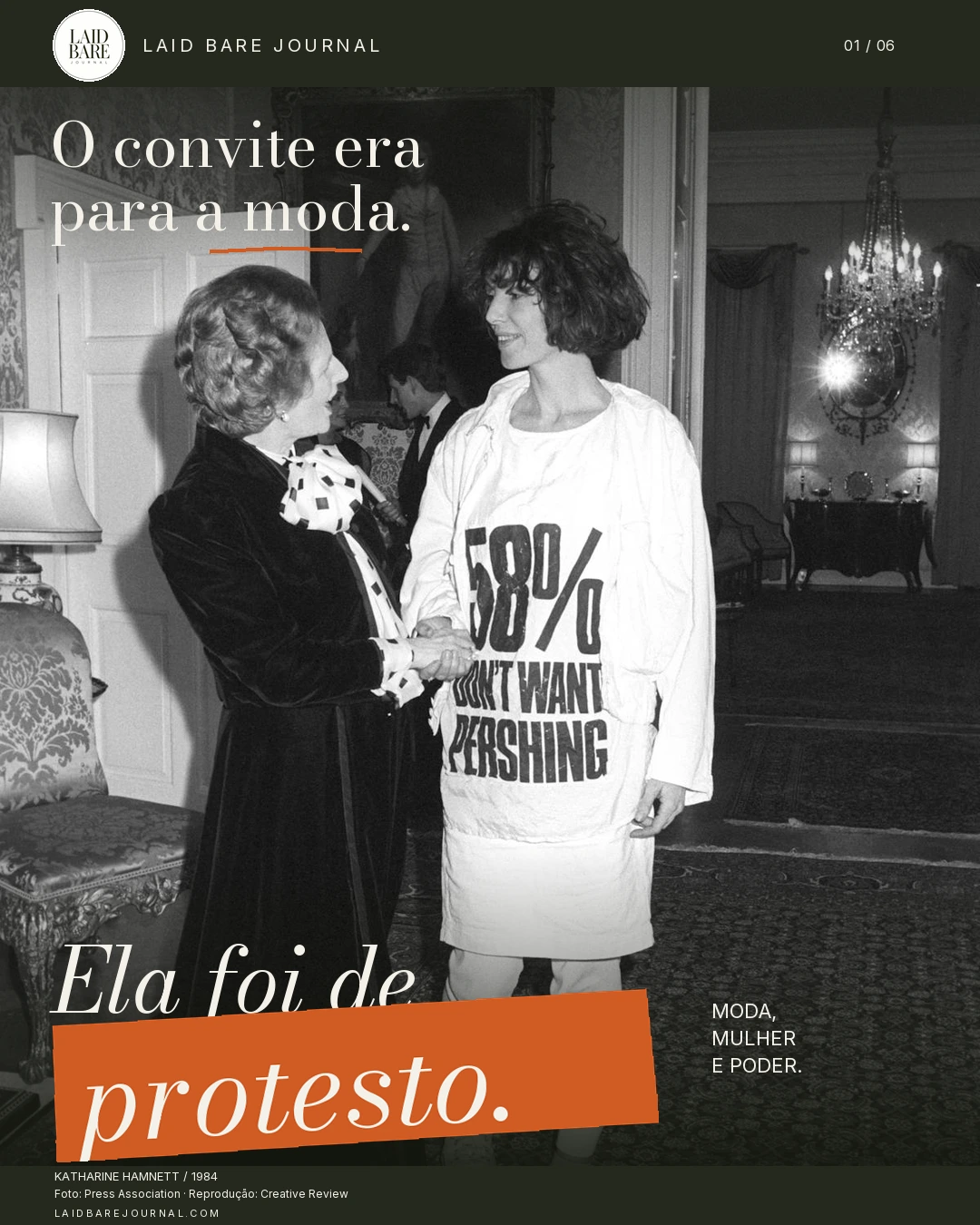

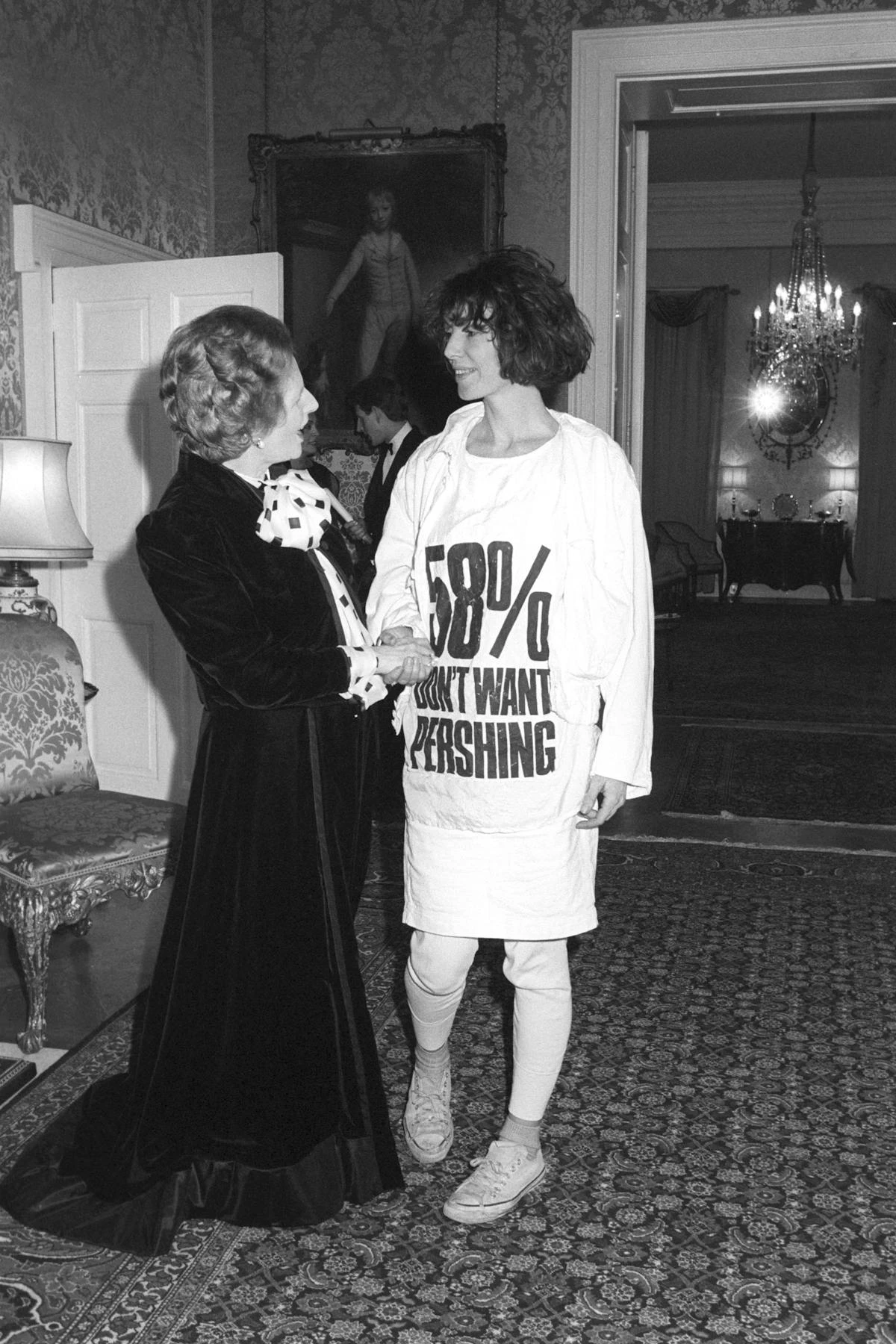
Margaret Thatcher extends her hand. Katharine Hamnett returns the greeting. A perfectly suitable photograph for a British government reception with people from the fashion industry.
Except the T-shirt had its own agenda.
“58% DON’T WANT PERSHING”, read Hamnett’s print, a message opposing Pershing nuclear missiles in Europe. In 1984, the designer took that disagreement into a meeting with the prime minister at Downing Street.
She knew there would be cameras.
Hamnett told British Vogue that she made the T-shirt that afternoon and kept her coat closed until she approached Thatcher. The reception offered a chance to be photographed alongside the prime minister. She decided what she would bring into the picture. British Vogue.
Attending did not mean agreeing. With lettering like that, the two would be hard to confuse.
Dissent in the frame
Think of the image expected from a reception like this: greetings, smiles, fashion professionals being welcomed by the government. Hamnett was there as a guest and used that proximity to make a criticism.
The T-shirt worked because it was part of the scene. It was worn by the person shaking Thatcher’s hand, its message large enough to read. Anyone publishing the photograph would carry the message with it.
There is a fashion intelligence in that gesture: understanding proportion, contrast and how a garment appears in a picture. Hamnett used that knowledge to put dissent into circulation.
It is a useful starting point for looking more closely at other clothes. A phrase, an embroidery or someone’s presence on a runway may have a reason the photograph alone cannot explain.
What Zuzu embroidered while searching for Stuart
In 1971, Zuzu Angel presented a collection in New York following the arrest and disappearance of her son Stuart during Brazil’s dictatorship. The show took place at the Brazilian consul’s residence and brought his case to public attention.
Uniforms, military caps, aircraft, cannons and caged birds appeared in the embroidery. Repression entered the clothes of a designer who already had clients and recognition abroad. Ocupação Zuzu Angel, Itaú Cultural.
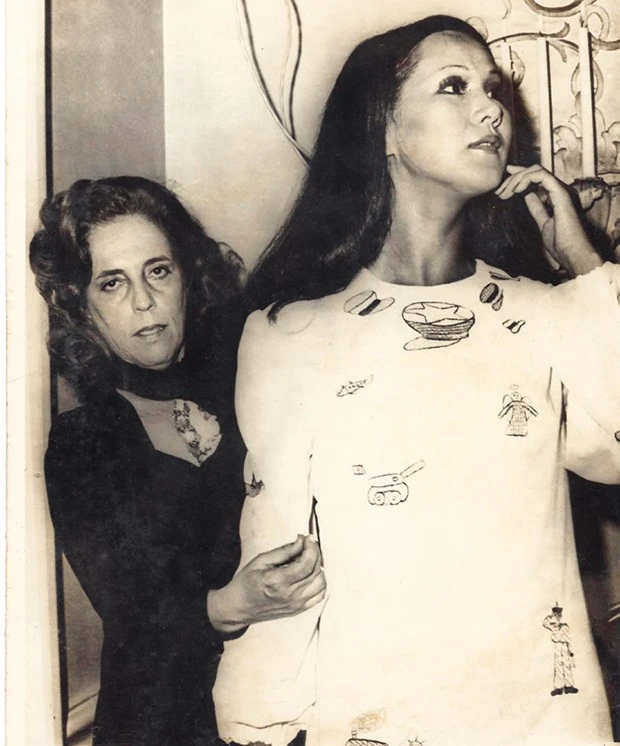
Zuzu was searching for her son. Her denunciation had a name, an urgency and a regime to confront.
Looking at those embroideries only as an aesthetic choice leaves out what prompted their creation. A drawing that might appear delicate carried an accusation. Knowing who made it, and under what circumstances, changes how we read the garment.
The connection with Hamnett lies in using one’s own work to make a position public. Their circumstances were profoundly different. Recognising that difference is part of understanding the force of each gesture.
The river had someone to speak for it
At the end of Nalimo’s “Natureza Surreal” show, models and activists raised placards. Among them was an appeal: “Save the Watu River”.
Day Molina’s show took place in São Paulo in December 2024, with the participation of Shirley Krenak. The activist spoke about the consequences of the Fundão dam collapse in Mariana for the Rio Doce, known as Watu, and for her people’s lives. Greenpeace activists also joined the mobilisation. Greenpeace Brasil.
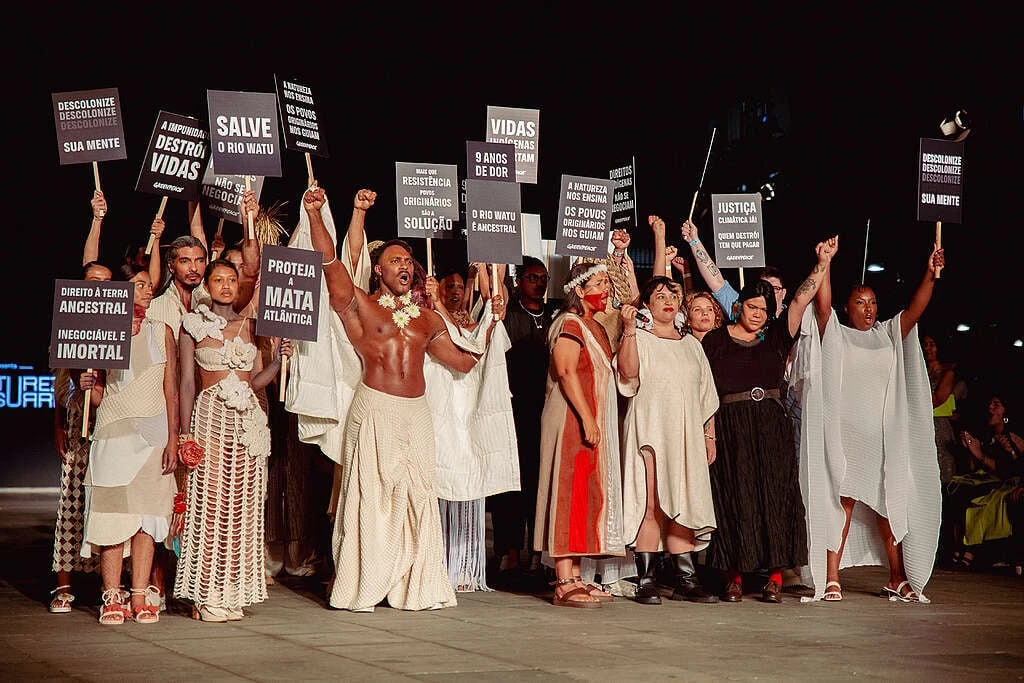
It matters which river they were speaking about. It also matters who was there to demand justice.
Shirley brought an affected community’s experience into that space. Her presence offered the audience something a visual reference to nature could not: an account of the relationship with the river and what its destruction had interrupted.
The audience had come to see a collection. They also heard a demand from someone still living with the consequences of a disaster.
The red beneath the nose
At first glance, a photograph from Renata Buzzo’s show might catch the eye because of the model’s face, the fabric or that red in the makeup.
At São Paulo Fashion Week in October 2024, the designer presented a collection about violence against women and femicide. Garments featured representations of internal organs; the makeup simulated blood running beneath the nose. SPFW archive.
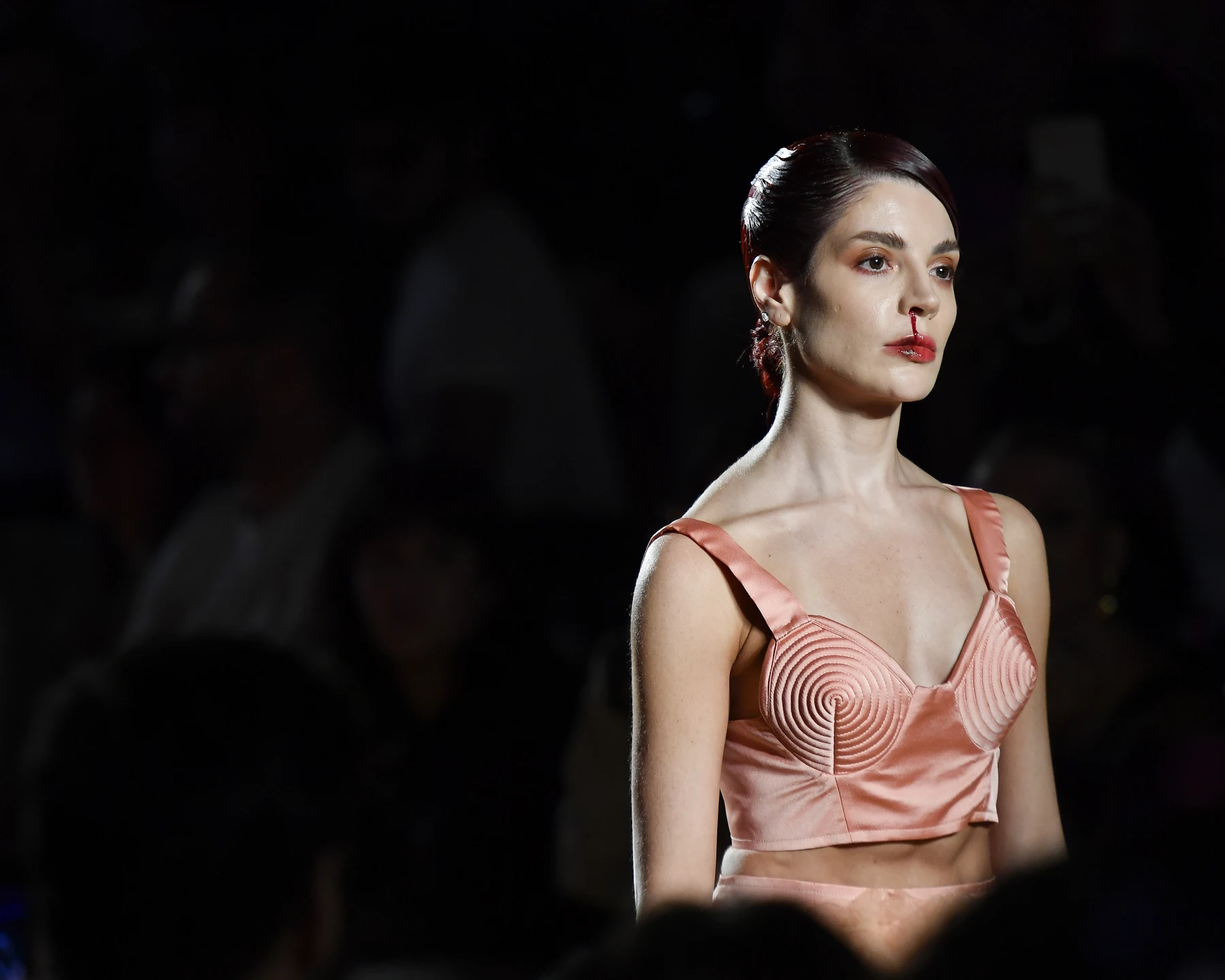
Knowing the theme prevents that detail from being treated merely as a beauty idea for next season. It belongs to a decision about what to put before the public.
This does not close the conversation about the collection. It opens up questions about how the violence was represented, what the image communicates and what needs explaining for its denunciation to be understood.
A garment can spark interest before we know what prompted it.
The photograph circulated. Now what?
The power of Hamnett’s image lies in the meeting of a garment, a message and an occasion. She brought a criticism to Thatcher and made it appear in the record of their greeting. The photograph shows us that. It cannot, on its own, tell us that a policy changed.
That distinction helps us look at fashion shows, too. Making a cause visible can open a conversation, reach other people and create space for a demand. What follows needs watching: who continues to be heard, which commitments are made and whether a brand’s practices support what it presents.
Those of us who love fashion can want to know everything about the cut of a dress and also why it exists in that particular form.
Who is speaking? What are they demanding? Who will have to answer?
Those questions belong in front of a runway, too.
That is also why fashion is political.