
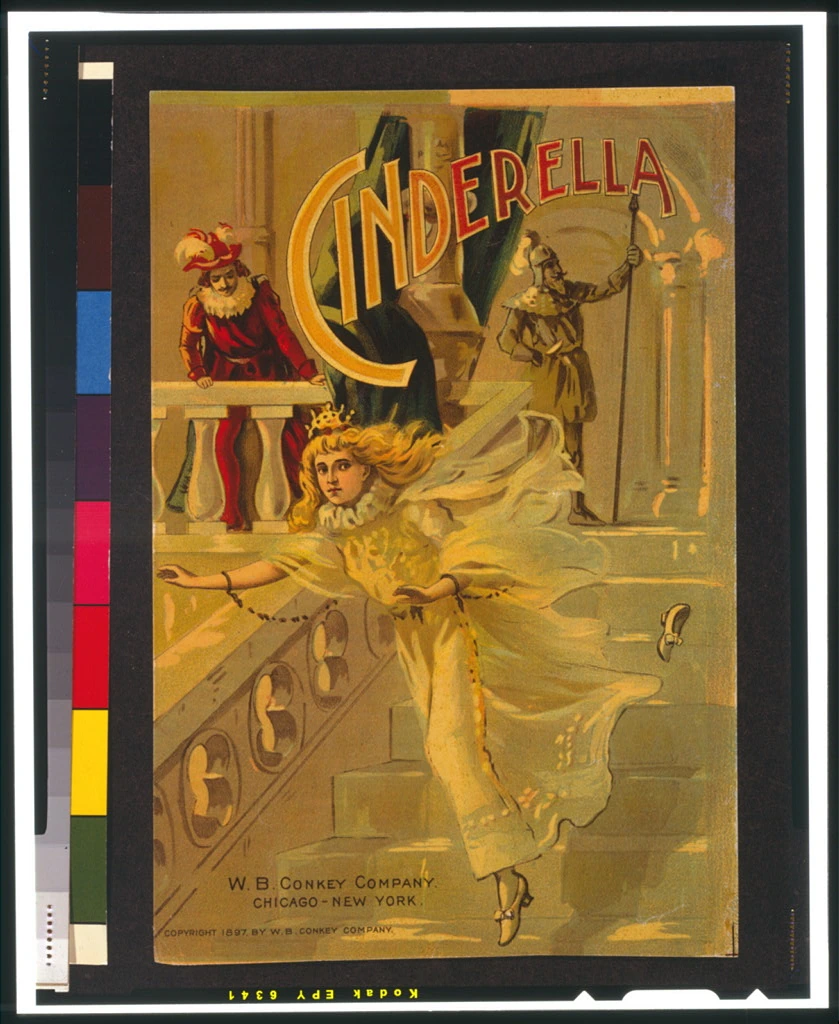
Cinderella’s glass slipper never has to defend its beauty. The story arrives before it does, promising elegance, delicacy and transformation. The Tabi turns up with a split between the big toe and the rest. The reaction can be almost physical: why is the foot divided? Is it beautiful? Does it look like a hoof? Perhaps that unease also says something about the kind of foot we expect to find inside a shoe.
I put the two side by side in Laid Bare Journal’s first post. They come from different traditions. What interests me is the reaction each provokes: the glass slipper is usually accepted as a symbol of elegance with very little debate; the Tabi gets a question before it gets a compliment. Why the difference?
01 / Before Paris, another way to dress the foot
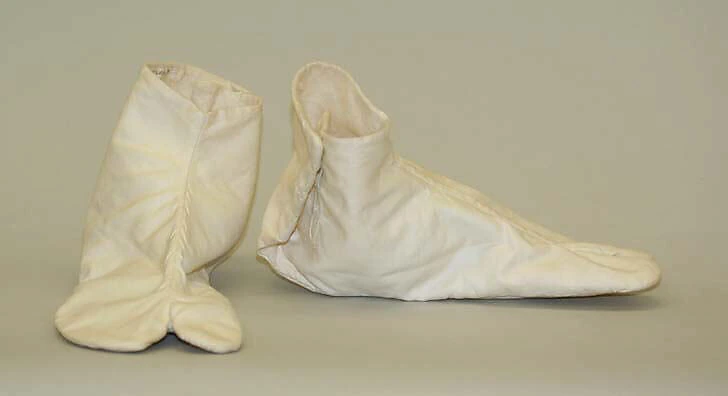
The word tabi did not originate at Maison Margiela, the fashion house founded by Belgian designer Martin Margiela. In Japan, it refers to socks with a separate compartment for the big toe, made to be worn with thong sandals. In Kyoto, craftspeople make kyo-tabi with particular attention to fit: the traditional fabric has little give. The split has a practical purpose. Knowing how it was used changes a first impression of the boot, without obliging anyone to like it. 12
The Bata Shoe Museum in Toronto, dedicated to the history of footwear, holds Japanese examples from the 20th century, catalogued as S82.76 and S79.76. Its record describes firm cotton, metal fasteners behind the heel and the split made for the straps of zōri and geta sandals. It also notes the use of white tabi in formal dress and indoors, after shoes have been removed. The split was not an isolated detail: it worked with the footwear and the habits around it. 10
Maison Margiela traces the Japanese socks that inspired its Tabi to the 15th century. That is the house’s account of the idea’s origins, not proof that the sock and the boot have been the same thing for five hundred years. A fabric tabi worn with sandals in Japan and a heeled leather boot made for Parisian fashion serve different purposes. The split survived the change in material, place and function. 3
FROM THE BOOK / ALL ABOUT SHOES
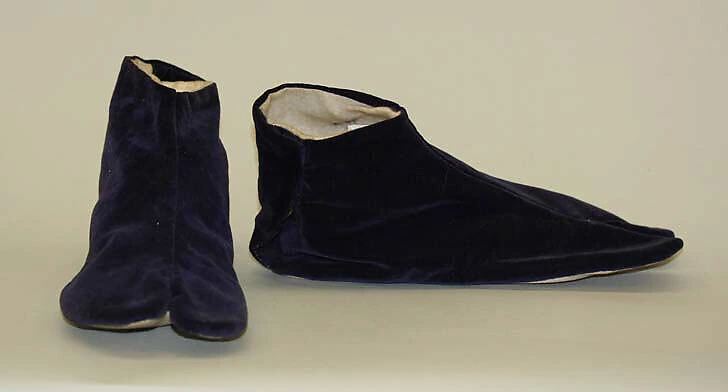
Before it became fashion, this shape had work to do.
On page 18, the What’s Their Line? section of All About Shoes brings together footwear made for specific tasks. A tabi boot worn by workers in Japan had a soft rubber sole to grip sloping roofs. The book does not say it inspired Maison Margiela, and I’m not going to invent that connection. The comparison is elsewhere: the same split appears in a work boot and a runway boot. 11
02 / A mark left on the floor
In 1988, Belgian designer Martin Margiela presented his house’s first collection, for spring/summer 1989. The house gives 1988 as the year the Tabi debuted; the Metropolitan Museum of Art records 1989 when identifying the show by its season. One date names the year, the other the collection. No dispute here, just two ways of cataloguing the same beginning. 34
For that first show, Margiela turned the sock reference into a heeled boot with a split toe. According to the house, the soles were dipped in red paint, leaving divided footprints along the models’ path. It was a simple, powerful gesture: the shoe’s design did not end at the body. It carried on across the floor, a trace the audience could read after the models had passed. 3
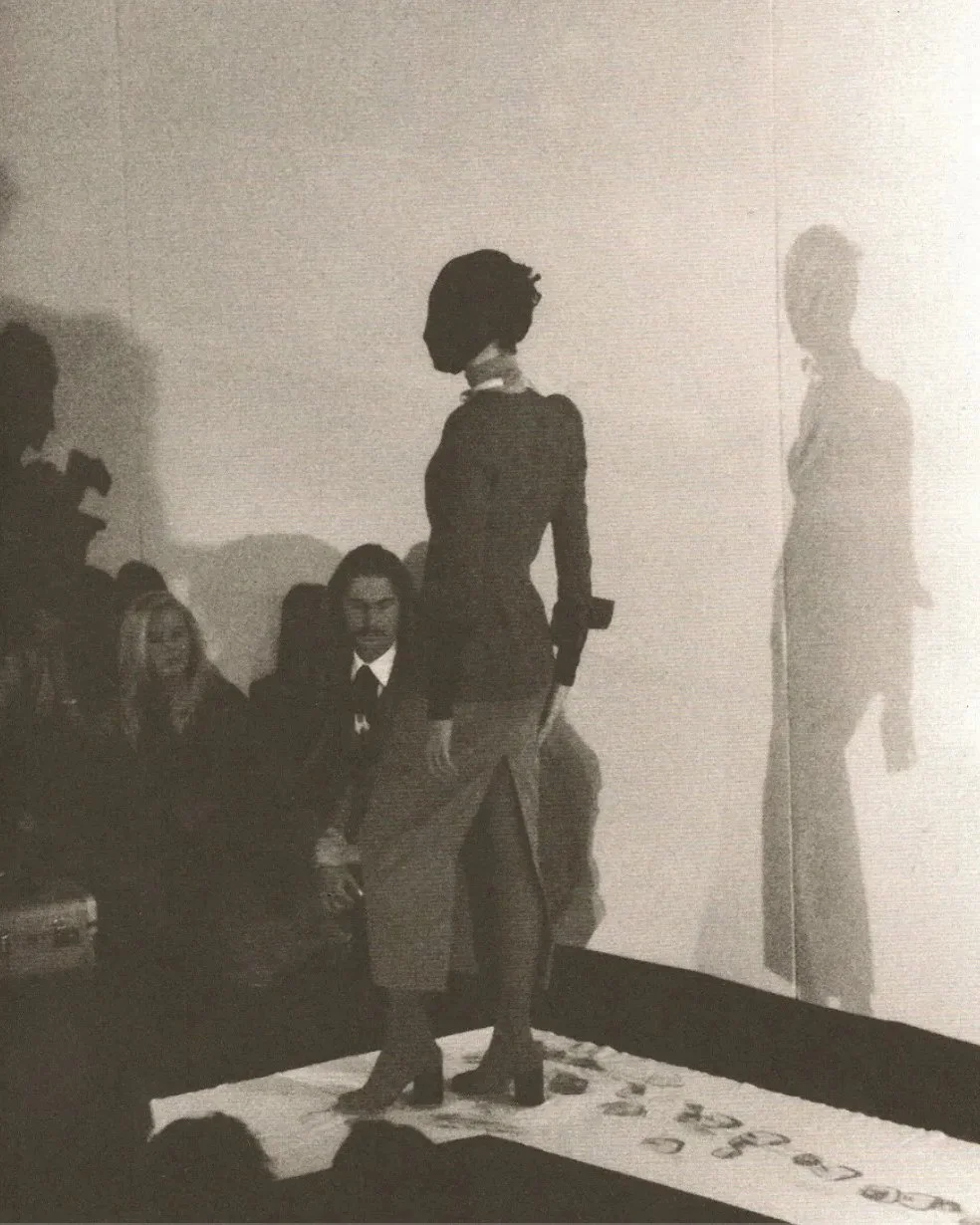
At a fashion show, a shoe is usually judged by what we see on the foot: shape, material, finish. Here, there was something else to look at. After the models had passed, the red sole marks remained. We don’t know whether Margiela intended them as a message; we do know they made the floor part of the image.
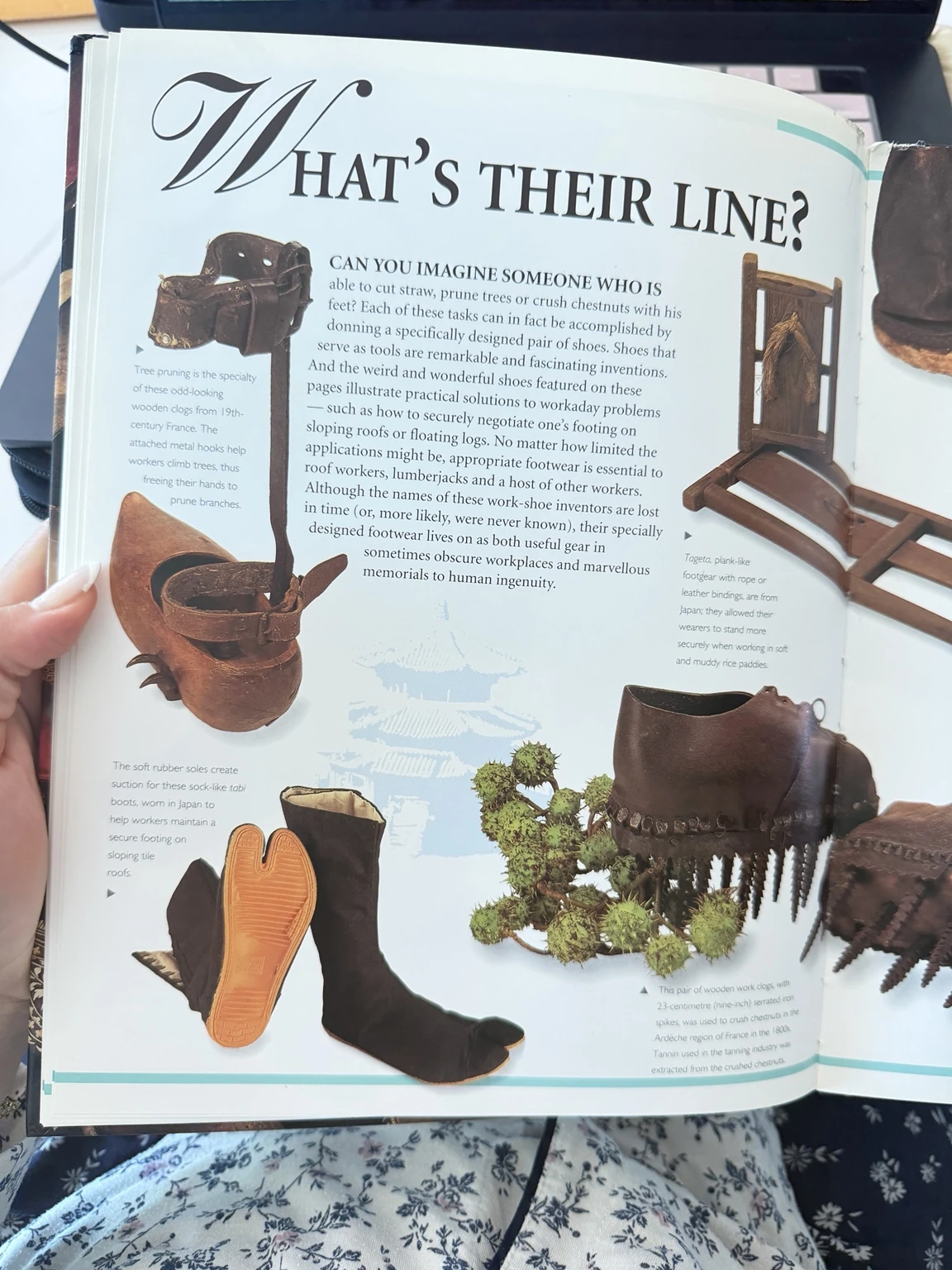
A 1994–95 pair held by the National Gallery of Victoria, a museum in Melbourne, shows the boot at another stage in the house’s history. The record lists materials, dimensions and provenance. It gives us an actual object to compare with the boot from the debut show.
A white pair from 1991–92, now at the Metropolitan Museum of Art, shows that the Tabi did not stay frozen at its debut. The heel, material and colour changed; the split at the front remained. Across different versions, the shape became one of the house’s most recognisable signatures. The split stayed put, without asking permission. 5
03 / Beauty, the strange and what we learn to recognise
It’s tempting to tell this story as the victory of “ugly” over “beautiful”. But taste does not begin the instant we look. The glass slipper arrives with centuries of storytelling around it. French writer Charles Perrault published Cendrillon in 1697; the glass slipper is even in the title. There, the shoe becomes proof of distinction and a promise of transformation. 6
In the tale, the shoe identifies the right person. Nobody stops the scene to ask whether the slipper is comfortable or plausible. The Tabi has no transformation soundtrack: the split is there for everyone to see. And the closed shoe, so familiar, is also a choice of shape. When we call the Tabi elegant, ridiculous or sophisticated, we are talking about the boot and a little about the person looking. Which word comes first for you?
The Costume Institute, the Met’s fashion department, also explored this boundary in Schiaparelli and Prada: Impossible Conversations. The exhibition brought designers Elsa Schiaparelli and Miuccia Prada into dialogue and devoted a section to “Ugly Chic”. It offers a way to read the Tabi: what one era calls ugly can become a sign of inventiveness in the next. Who decides when that happens? 7
04 / Okay. Why does this matter?
That change in reaction is what interests me. The split is still in the same place, but today many people recognise the boot before they find it strange. Fashion does this often: it repeats a shape until the shape no longer has to ask permission. What has to happen for the strange to become familiar? 5
The Met also points to a habit of Margiela’s: showing how clothes are made and reusing old garments. In one piece, he cut up a 1950s ball gown and turned it into a jacket. That helps explain why the Tabi deserves a closer look: its shape has a Japanese history, found another life at a Parisian fashion house and is still worn today. An idea and its use can fit inside the same shoe. 89
I put the glass slipper beside the Tabi because the contrast interested me. Now it’s the glass that gives me more trouble. I grew up with a story in which fitting that shoe proved a woman deserved to be chosen; for a long time, I thought that was simply romantic. The Tabi, with its split on full display, often has to justify its beauty. The glass rarely faces the same interrogation. Knowing a piece does not oblige anyone to like it. But when I call one strange and the other a dream, I stop and ask myself where that difference came from. Had you ever thought about it?
Sources and further reading
National Gallery of Victoria, Boots, Maison Martin Margiela: the purpose of the split in the Japanese sock and the boot’s museum record.
Kyoto City Official Travel Guide, Kyoto Craftmanship: Kyo-tabi: the making and fit of traditional socks.
Maison Margiela, The Tabi: the house’s account of the inspiration, debut and red footprints.
The Metropolitan Museum of Art, Shirt, Maison Margiela: the first Paris presentation identified as spring/summer 1989.
The Metropolitan Museum of Art, Shoes, Maison Margiela: the Tabi’s continuity and variations, including the 1991–92 pair.
Bibliothèque nationale de France, La pantoufle de verre: an excerpt from Charles Perrault’s Cendrillon (1697), used as a literary counterpoint.
The Metropolitan Museum of Art, Schiaparelli and Prada: Impossible Conversations: the curatorial description of “Ugly Chic”.
The Metropolitan Museum of Art, Jacket, Maison Margiela: deconstruction, recycling and other practices of the house.
The Metropolitan Museum of Art, Dress, Maison Margiela: a 1950s dress transformed into a jacket, and a critique of the body ideal.
Bata Shoe Museum, Socks, Socks and More Socks!: records for tabi pairs S82.76 and S79.76, with descriptions of materials, fasteners and uses.
Bata Industries / Bata Shoe Museum Foundation, All About Shoes: Footwear Through the Ages. Toronto: Bata Ltd., 1994, “What’s Their Line?”, p. 18 (Ana Raquel Cunha’s copy). ISBN 0-9692076-1-1. Bibliographic record. The information about the work boot and rubber sole comes from the photographed page. The comparison with Margiela’s Tabi is an editorial reading.
Phantasy, The Circuitous Life of the Tabi Shoe: a reproduction of the spring/summer 1989 show, credited to Raf Coolen. The same photograph appears in the material for MoMA’s Pirouette exhibition, p. 34 of the PDF, which identifies the collection and records the photographer as unknown. Maison Margiela confirms the Tabi’s 1988 debut and the soles dipped in red paint.